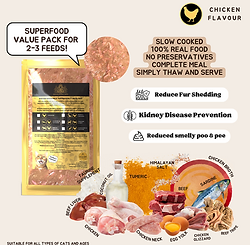
Gently cooked cat food beats kibble on moisture, meat content and digestibility; kibble wins on price and shelf convenience. For most Singapore households the practical answer is cooked food as the main diet, with kibble reserved for travel or boarding — if at all.
Side-by-side comparison
| Factor | Cooked Gourmet | Dry kibble |
|---|---|---|
| Moisture | 70–80% | 6–10% |
| Meat content | 80% | Typically 25–40% |
| Carbohydrate | Under 5% | 30–50% |
| Processing | Slow-cooked at low temperature | High-heat extrusion |
| Digestibility | 90%+ | 70–80% |
| Preservatives | None | Usually required |
| Shelf life | Frozen, months; chilled, days | Months at room temperature |
| Cost per day | Higher | Lower |
Why moisture is the deciding factor here
Cats evolved to get most of their water from prey and have a weak thirst drive. On a dry diet many cats live in mild chronic dehydration, which is one of the reasons urinary tract issues are so common in indoor Singapore cats. A cooked diet at 70–80% moisture delivers water with every meal, without you having to persuade your cat to drink.
Where kibble still makes sense
- Travel, boarding or a pet-sitter who cannot manage a cold chain
- Puzzle feeders and slow-feeder enrichment
- Tight budgets — an under-fed cat on a fresh diet is worse than a well-fed cat on kibble
If you mix, feed them at separate meals four to six hours apart; cooked food and kibble digest at different rates.
Cooked vs raw
Cooked food eliminates raw-handling concerns while keeping human-grade ingredients and the same 80/10/10 meat, bone and offal ratio. It is the option we recommend for households with young children, elderly members, or a cat with a compromised immune system. Raw retains slightly more nutrients — the full comparison is in our fresh vs raw guide.
How to switch from kibble
A two to four week transition avoids stomach upset:
- Week 1: 25% cooked, 75% current food
- Week 2: 50/50
- Week 3: 75% cooked
- Week 4: 100% cooked
For picky eaters, warm the food slightly to release aroma, start with chicken or duck, and only offer at set meal times. Some cats take two to three weeks to accept a new texture.
Try it
Cooked Gourmet comes as ready-cooked recipes in 200g packs, in six flavours from $7 a pack, with island-wide delivery on Monday, Wednesday and Friday. Delivery is free when your food total after discounts is $210 or more. Prefer raw? See the Raw Gourmet range.
Continue Your Learning
Explore these related guides for more helpful information:
Related Guides You'll Love
Continue reading:
Continue in the Cat Nutrition guide
This article is one chapter of a larger Singapore guide. The hub links every related chapter in reading order.
Open the Cat Nutrition hub- Raw vs gently cooked cat foodThe trade-offs between the two fresh feeding approaches.
- Raw feeding guideSafe handling, balance and portioning for raw diets.
- Raw feeding safety and storageCold chain, thawing windows and kitchen hygiene in Singapore's climate.
- How much raw food to feed a catDaily grams by ideal body weight for kittens, adults and seniors.
- Raw cat food cost in SingaporeCost per day and month against premium kibble and canned food.
- Kitten feeding scheduleGrowth-stage portions and meal frequency.
References & Authoritative Sources
Written by our editorial team from the authoritative veterinary, government and registry sources listed below. For a concern about your own cat, please speak to a veterinarian.
- Animal & Veterinary Service (AVS), Singapore — Pet licensing & welfare standards
- WSAVA Vaccination Guidelines — Global feline vaccination protocol
- AAFP Feline Life Stage Guidelines — Veterinary care across life stages
- Cat Fanciers' Association (CFA) — Breed standards & registry
- The International Cat Association (TICA) — Breed standards & registry
- FIFe — Fédération Internationale Féline — International breed standards